

Injection site rotation: why it matters and how to do it
Why repeated injections in one spot cause lipohypertrophy, how far apart to space sites, and simple rotation patterns for abdomen, thigh and arm.
Read articleNeedle gauge measures thickness and runs backwards: higher numbers are thinner. What gauge and length mean for subcutaneous injections.
Needle gauge is the number that describes how thick a needle is, and the scale runs backwards: the higher the number, the thinner the needle. Needles for subcutaneous injections are thin and short. CDC guidance for subcutaneous vaccine injections specifies a 5/8 inch, 23- to 25-gauge needle at a 45-degree angle, while the pen needles studied in diabetes care are shorter (commonly 4 to 8 mm) and thinner (29 to 32 gauge). The pharmacy or prescriber that supplies your medication also specifies the needle, so ask before using a different one.
Gauge describes the outside diameter of the needle. Length is measured from the tip to the point where the needle meets the hub, written in millimeters on most pen needles and in fractions of an inch on many syringes. For reference, 4 mm is a little over 1/8 inch, 8 mm is about 5/16 inch, and 5/8 inch is about 16 mm.
Both numbers usually appear together on the package, such as 31G 5 mm or 25G 5/8 inch, and they do different jobs. Length decides which layer of tissue the medication lands in. Gauge decides how wide the opening is.
Neither number is the same as the syringe markings that show how much liquid you are drawing up. If you use an insulin syringe, the unit lines are a separate system, explained in how to read an insulin syringe.
A higher gauge number means a thinner needle, so a 32-gauge needle is thinner than a 25-gauge one. That is why a needle gauge chart looks upside down at first glance.
CDC lists 23- to 25-gauge needles for subcutaneous vaccine injections and 22- to 25-gauge for intramuscular injections. The insulin pen needles compared in published injection technique studies are much thinner. A 2015 review in Diabetes Spectrum describes crossover studies that used 32-gauge 4 mm, 31-gauge 5 mm, 31-gauge 8 mm and 29-gauge 12.7 mm pen needles.
A very thin needle can also bend. In the patient case reported in that same review, a woman using pen needles found they were often bent when she pulled them out, which turned out to be related to how she held the pen.
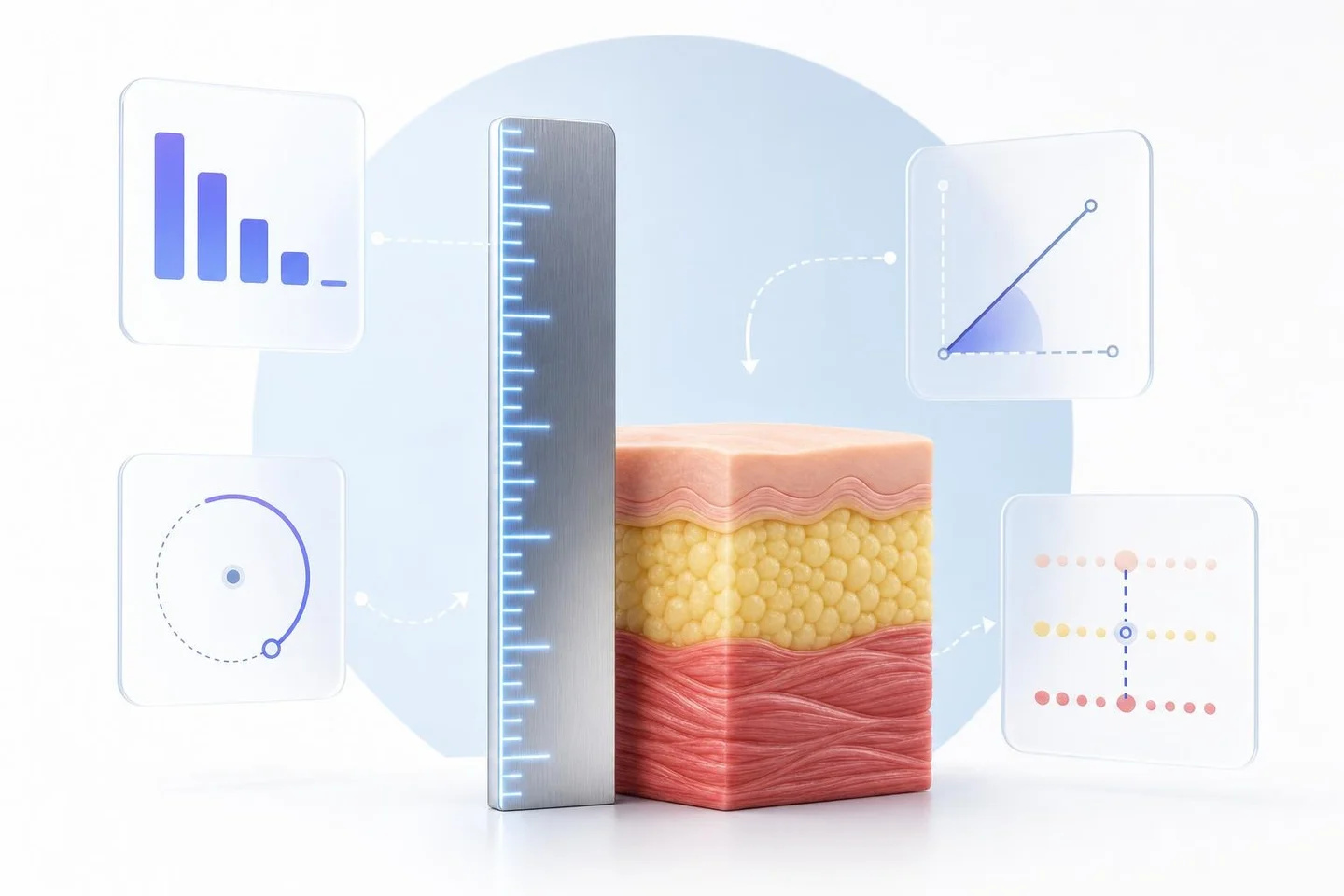
Subcutaneous tissue is the layer of fat that sits between the skin and the muscle. A subcutaneous injection is meant to deposit medication in that fat layer, which is why the needles are short.
The Diabetes Spectrum review summarizes a study by Gibney and colleagues that measured 388 people with body mass index values from 19.4 to 64.5. Average skin thickness ranged from 1.9 to 2.4 mm at the arm, thigh, abdomen and buttocks, and average subcutaneous thickness across those sites ranged from 10.35 mm to 15.45 mm. Skin thickness varied little with body size.
Because the skin itself is only a couple of millimeters thick, a 4 mm needle passes through it in most adults. The International Scientific Advisory Board for the Third Injection Technique Workshop concluded in 2010 that there is no medical reason to recommend a needle longer than 8 mm, and recommended needles of 4 to 6 mm for adults regardless of body mass index.
Those recommendations were written for insulin injections in people with diabetes, and the evidence behind them is more than a decade old. They are not automatically the right answer for every injected medication. CDC's subcutaneous vaccine standard, for example, is a longer 5/8 inch needle used at a 45-degree angle rather than straight in.
Angle and length work together. The injection technique board recommended inserting needles of 4 to 6 mm at a 90-degree angle, and using either a skinfold or a 45-degree angle with longer needles to avoid putting insulin into muscle. CDC's subcutaneous vaccine instruction follows the same logic from the other direction: a longer needle, angled at 45 degrees, so the tip stays in the fat layer.
Depth matters because muscle absorbs medication differently. The Diabetes Spectrum review notes that shorter needles are less likely to result in an intramuscular injection and the erratic glucose absorption that can follow with insulin.
CDC also makes the point that needle length and injection site are decisions made for each person, based on the size of the muscle, the thickness of fat at the site, the volume being injected and the injection technique used.
The needle that comes with your medication was chosen for that medication, that volume and that route. A longer needle left over from something else can change which tissue layer the medication reaches. If your kit is missing needles, the wrong size arrived, or you have trouble pushing the plunger, contact the pharmacy or your clinician rather than improvising.
Needles and syringes are single use. The WHO injection safety toolkit defines a safe injection as one that does not harm the person receiving it, does not expose the person giving it to avoidable risk, and does not create waste that is dangerous to others. The same document lists reuse of injection equipment and two-handed recapping among the practices that cause harm. Used needles go in a sharps container, not in household trash.
If the medication you inject is compounded, one more point is worth knowing: compounded drugs are not FDA-approved, which means FDA does not verify their safety, effectiveness or quality before they are marketed. Either way, the prescriber and pharmacy are the people who decide what needle and syringe go with it.
Step-by-step technique, including site rotation and how to hold the skin, is covered in how to give a subcutaneous injection at home.
Shorter needles are not automatically the right choice for everyone. The Diabetes Spectrum review points out that the studies supporting short needles enrolled people without physical or cognitive limitations, and that people with arthritis, tremor, carpal tunnel syndrome, vision loss or other conditions that affect hand movement may not insert a short needle fully, even after training. In that review's case report, a woman with arthritis who used both hands to deliver her injection was unintentionally pulling the needle partway out during the injection.
Call a clinician if you cannot give the injection as instructed, if the needle bends or you are unsure the full dose went in, or if an injection site becomes increasingly painful, swollen, warm or red, or starts draining fluid. Normal and abnormal site changes are described in injection site reactions.
Seek urgent care for signs of a severe allergic reaction after any injection, such as trouble breathing, swelling of the face, lips or throat, or a sudden widespread rash. If you stick yourself with a used needle, contact a clinician that day.
Not better, just thinner. CDC lists 23- to 25-gauge needles for subcutaneous vaccine injections, while the insulin pen needles used in the technique studies summarized in Diabetes Spectrum were 29 to 32 gauge. The right gauge depends on the medication and the device it comes in, which is why your prescriber or pharmacy specifies it.
That is what the injection technique research in diabetes suggests. The skin thickness measurements summarized in Diabetes Spectrum averaged 1.9 to 2.4 mm regardless of body size, and the 2010 injection technique board recommended needles in the 4 to 6 mm range for adults regardless of body mass index. Those findings come from insulin studies, so apply them to your own medication only after asking the prescriber.
No. The amount of medication is set by the prescribing clinician and measured by the markings on the syringe or the dial on the pen, not by the needle.
No. The WHO injection safety toolkit identifies reuse of syringes and needles as a practice that exposes people to bloodborne pathogens, directly through contaminated equipment or indirectly through contaminated vials. Use a new needle each time and put it in a sharps container.
Why repeated injections in one spot cause lipohypertrophy, how far apart to space sites, and simple rotation patterns for abdomen, thigh and arm.
Read articleU-100 markings explained: what a unit on the barrel means, why 0.3, 0.5 and 1 mL syringes differ, and how to line the plunger up with the right mark.
Read articleWhat a normal injection site reaction looks like, what a lump or redness means, and the signs of infection or allergy that need prompt care.
Read articleOpening soon
SimpleHumans is opening soon. Join the early-access list and you'll be first to know when we launch — plus an exclusive discount reserved for people who sign up before we open.
You're on the list
Thanks for joining. We'll email you when we launch, along with your founding-member discount.

