

Female pattern hair loss: signs, causes and diagnosis
What female pattern hair loss looks like, why the part widens while the hairline stays, and the conditions a clinician checks for first.
Read articleHair shedding and hair loss are different problems. What counts as normal daily shedding, what telogen effluvium is, and the signs of pattern loss.
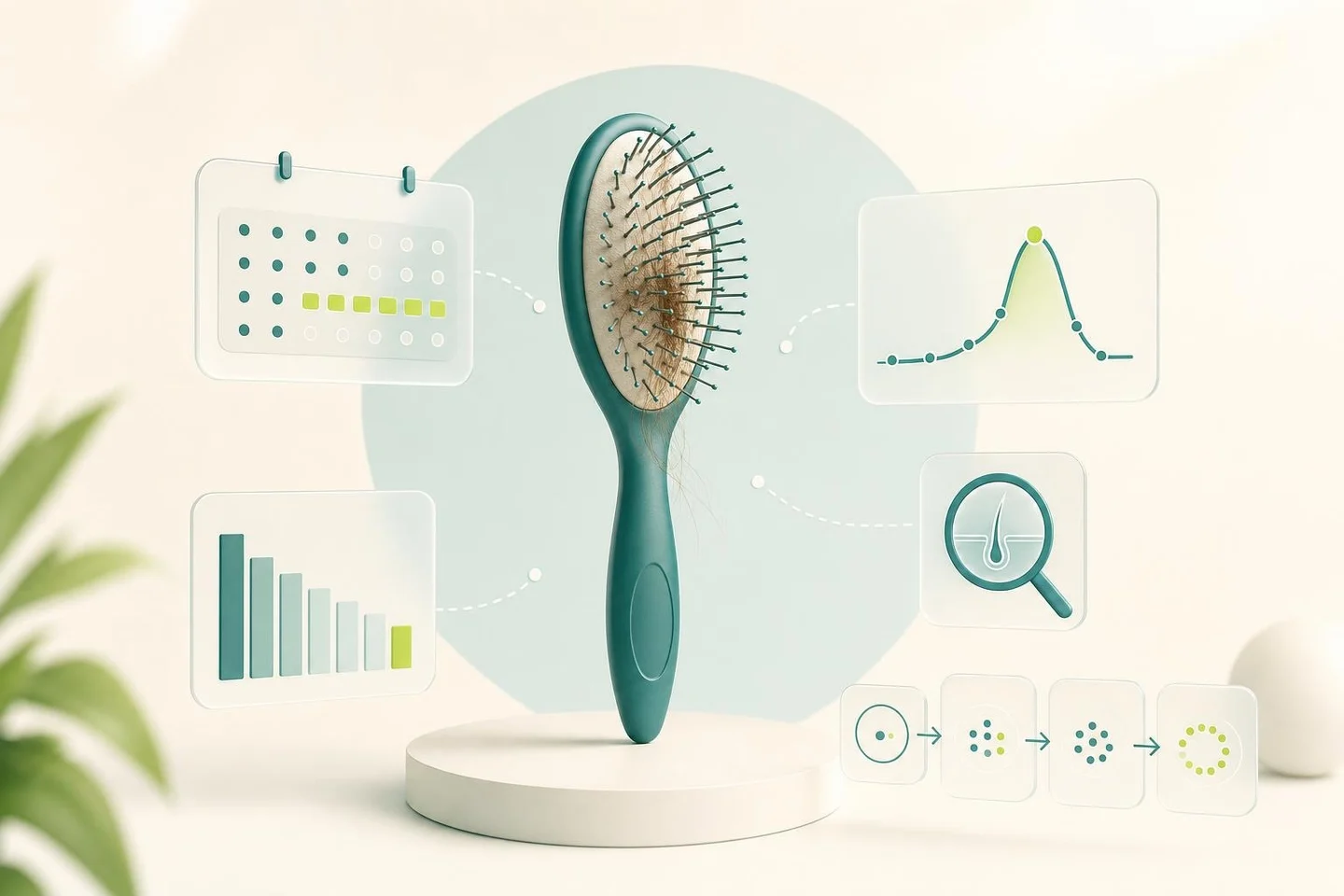
Hair shedding and hair loss are different problems, and the difference matters because the causes and outcomes differ. Shedding means hairs fall out that the follicle will replace, while hair loss means something has stopped the hair from growing. The American Academy of Dermatology (AAD) puts normal shedding at 50 to 100 hairs a day, and calls heavier than normal shedding telogen effluvium.
Between 50 and 100 hairs a day is normal. Hair cycles through growth (anagen), involution (catagen), rest (telogen) and shedding (exogen), and that shedding phase accounts for roughly 100 hairs a day.
Counting is possible, though few people need to do it. In clinics, shed hair is collected over 24 hours without washing, and 100 or more hairs suggests telogen effluvium.
Washing and styling do not cause the shedding, so there is no reason to stop.
Telogen effluvium is a non-scarring type of hair loss in which many hairs shift early into the resting phase and then shed together. The hairs stop growing for 1 to 6 months, averaging about 3 months, and the shedding shows up when those resting hairs are pushed out as new growth begins.
Common triggers include acute fever, severe infection, major surgery, the hormonal shift after giving birth, hypothyroidism, crash dieting and iron deficiency. Beta-blockers and retinoids have been linked to it too. AAD lists similar stressors, including losing 20 pounds or more, heavy life stress and an operation.
The trigger often comes about 3 months before the shedding starts, so many people have recovered and do not connect the two.
AAD says that as the body readjusts the excessive shedding stops, and within six to nine months hair tends to regain its normal fullness. If the stressor stays, though, the shedding can be long lived.
Pattern hair loss, also called androgenetic alopecia, is inherited thinning in which follicles gradually shrink and produce finer, shorter hairs. StatPearls calls this follicular miniaturization: androgen receptor activation shortens the growth phase, so follicles make thinner, shorter hairs over time. The same chapter reports it affects roughly 50% of males and females. In Caucasian men about 50% are affected by age 50 and about 80% by age 70, and in women the incidence rises after menopause.
AAD lists the early signs as gradual thinning on top of the head, a bald spot that grows slowly, a receding hairline, a widening part and a thinner ponytail. These signs appear so gradually that people can have hair loss for months or years before noticing.
AAD notes that some people have both hair loss and excessive shedding.
For suspected telogen effluvium, testing often looks at thyroid function and iron status. If the shedding followed a problem such as low iron, growth returns once that is corrected, and if a medication caused it, growth restarts after the medication is withdrawn. Topical minoxidil has not been proven to promote recovery in telogen effluvium.
For pattern hair loss, StatPearls lists two FDA-approved treatments: topical minoxidil and finasteride. Both take at least 4 to 6 months of consistent use before any change is visible, and both must be continued to keep whatever is gained. The same chapter says finasteride's effect in female pattern hair loss remains uncertain and that finasteride is contraindicated for women of reproductive potential, so it is used in men. Starting either can trigger an initial shedding phase, covered in our article on what studies report about oral minoxidil shedding. The prescribing clinician decides the form and strength.
SimpleHumans offers prescription hair loss treatments in three options: a finasteride, minoxidil and biotin capsule, a finasteride and minoxidil topical solution, or oral minoxidil. A clinician chooses one after reviewing your history, and oral finasteride is prescribed for men only. These are compounded medications. Compounded drugs are not FDA-approved, which means FDA does not verify their safety, effectiveness or quality before they are marketed. Trials of FDA-approved topical minoxidil and FDA-approved finasteride products are not evidence for a compounded version.
Topical and oral minoxidil carry different risks. For topical minoxidil, StatPearls lists the most common adverse effects as itching and local irritation that can lead to flaking, often from the propylene glycol or alcohol in the formulation.
Oral minoxidil acts on the whole body. The FDA-approved oral product is approved only for severe refractory hypertension, so hair-loss use is off-label. A 2025 narrative review of low-dose oral minoxidil in the Journal of Clinical Medicine reports that the most frequent adverse effect is hypertrichosis, unwanted hair on the face or body, in about 15% of patients, more often in women and at higher doses. Fluid retention affected 1.3% to 10% of patients, usually in the first 1 to 3 months. Tachycardia (a fast heart rate) or dizziness occurred in fewer than 5% of cases, usually mild and temporary. Severe events such as pericardial effusion (fluid around the heart) were extremely rare and often traced to compounding errors: in one series, the capsules of 12 women with severe reactions contained 10 to 100 times the prescribed dose.
The same review says oral minoxidil is contraindicated in people with pheochromocytoma or an allergy to a tablet component, and is not recommended for people with a recent heart attack, heart failure with left ventricular dysfunction, severe valve disease or advanced chronic kidney disease. If you have heart or kidney disease, or take blood pressure medication, oral minoxidil should not be started without a clinician weighing that history first.
Finasteride is contraindicated in women of reproductive potential because of the risk of ambiguous genital development in a male fetus, and that applies to any finasteride-containing option, capsule or topical solution. Possible adverse effects include sexual dysfunction and masking of PSA levels, which can delay prostate cancer detection. Our article on what the label and studies say about finasteride side effects goes through this in more detail.
Talk to a clinician if shedding lasts longer than about six months, if hair comes out in clumps, or if a bald patch appears quickly. Swelling in the legs or face, a racing heartbeat, shortness of breath or chest pain while taking oral minoxidil are reasons to seek care promptly.
Get medical care if hair loss comes with intense itching, burning and tenderness, which can signal an infection, or with scaly bald patches and sores that ooze pus, a sign of fungal scalp infection.
Yes. AAD describes 50 to 100 hairs a day as normal shedding, and clinicians treat 100 or more hairs collected over 24 hours as a sign of telogen effluvium.
Acute telogen effluvium lasts less than 6 months by definition, and AAD says fullness tends to return within six to nine months.
It can. In women, pattern hair loss is often unmasked by telogen effluvium 1 to 6 months after a stressor.
It usually does. Telogen effluvium is benign and spontaneously reversible, with no scarring, though full growth may take several months to a year.
If you are unsure which you have, note when the shedding started, whether anything happened about three months earlier, and whether your part or hairline has changed over years rather than months. That is what a clinician will ask first.
What female pattern hair loss looks like, why the part widens while the hairline stays, and the conditions a clinician checks for first.
Read articleHow inherited androgen sensitivity and DHT shrink scalp follicles, how pattern loss progresses, and which other causes of hair loss look similar.
Read articleOral minoxidil for women is off-label for hair loss. What the studies in women report, plus hypertrichosis, fluid retention and pregnancy warnings.
Read articleOpening soon
SimpleHumans is opening soon. Join the early-access list and you'll be first to know when we launch — plus an exclusive discount reserved for people who sign up before we open.
You're on the list
Thanks for joining. We'll email you when we launch, along with your founding-member discount.
