

Injection site rotation: why it matters and how to do it
Why repeated injections in one spot cause lipohypertrophy, how far apart to space sites, and simple rotation patterns for abdomen, thigh and arm.
Read articleHow units, mL and mg relate on a U-100 syringe, why vial concentration changes everything, and why your prescription label is the only dose source.
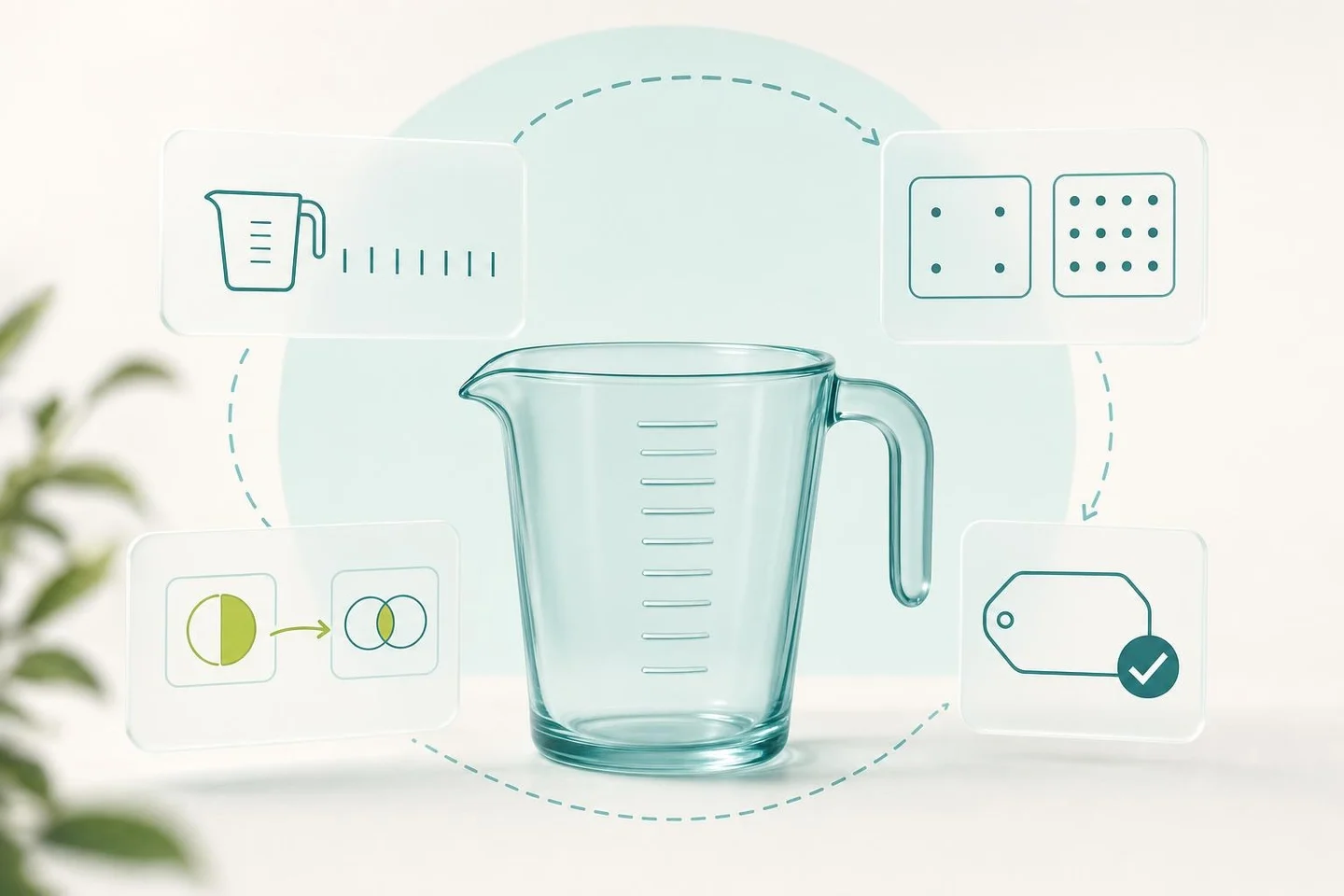
To convert compounded semaglutide units to mg, you need to know the concentration printed on your vial. On a U-100 insulin syringe, 100 units equals 1 mL, so the units tell you volume, not drug amount. The mg in each dose equals the mL you draw multiplied by the vial's concentration in mg per mL, and that concentration differs between pharmacies and fills.
This guide explains the math in general terms. It is not a dosing guide. Your prescription label and your prescriber's instructions are the only source for your dose.
Three different measurements show up with compounded injections:
The word "units" comes from insulin. The American Diabetes Association explains that insulin concentration is the number of units in 1 mL, and that U-100 means 100 units in 1 mL. When a compounded, non-insulin medicine is drawn up with a U-100 insulin syringe, the unit lines just mark hundredths of a milliliter. They say nothing about how much drug is in that liquid.
FDA has warned that confusion between mL, mg and "units" may have contributed to dosing errors with compounded semaglutide, and that some patients were unfamiliar with drawing medicine from a vial into a syringe.
On any U-100 insulin syringe:
Insulin syringes come in different sizes, and the gap between printed lines is not the same on every syringe. Before your first dose, check with your pharmacy what each line on your syringe represents. FDA encourages prescribers and compounders to give patients the right syringe size for the intended dose and to show them how to measure it.
Two steps connect units to milligrams:
Put together, mg per dose = (units ÷ 100) × concentration in mg/mL.
You can only do step 2 if you know the exact concentration of your vial. Without it, units cannot be turned into mg.
This is a made-up example to show the arithmetic. The concentration and the number of units are invented round numbers. They are not a dose recommendation for any medication and should not be compared with your own prescription.
Imagine a vial labeled with a made-up concentration of 10 mg/mL, and instructions to draw 30 units on a U-100 syringe.
In this pretend example, 30 units contains 3 mg of drug.
Now imagine the same 30 units drawn from a different made-up vial with a concentration of 5 mg/mL:
The syringe looks exactly the same, but the amount of drug is half. That is why a number of units only makes sense alongside a specific concentration.
FDA notes that compounded product concentrations may vary by compounder, and a single compounder may offer more than one concentration. Instructions may be written in units, and the volume behind a unit depends on the concentration.
Small mix-ups can mean large errors. In reports FDA reviewed, patients told to draw 5 units (0.05 mL) drew 50 units instead, which is ten times the intended amount. Other reports described health care providers converting mg to units incorrectly. Some patients who received too much sought medical care or were hospitalized. FDA's page on unapproved GLP-1 drugs encourages patients to talk with their prescriber or compounder about how to measure and give the intended dose.
Storage can also affect a vial, so see what to do if a compounded medication was left out of the fridge, and how beyond-use dates on compounded medications work.
Medicines such as compounded semaglutide and tirzepatide are prescription medicines, so follow your prescriber's instructions. Compounded drugs are not FDA-approved, and FDA does not verify their safety, effectiveness or quality before they are marketed.
It depends entirely on the concentration of your vial. 10 units on a U-100 syringe is 0.1 mL. Multiply 0.1 by the mg/mL on your label to get mg. If you're unsure, ask your pharmacy to confirm.
No. On a U-100 syringe, 1 unit is 0.01 mL of liquid. How many mg that holds depends on the concentration.
A new fill may have a different concentration. A prescriber can adjust the number of units so the mg dose stays as intended. Always follow the label on the vial you are using, and call the pharmacy if the instructions look different than you expect.
Use the syringe your pharmacy or prescriber provides or recommends. The unit markings described here apply to U-100 syringes, and syringe sizes differ.
Why repeated injections in one spot cause lipohypertrophy, how far apart to space sites, and simple rotation patterns for abdomen, thigh and arm.
Read articleWhat a normal injection site reaction looks like, what a lump or redness means, and the signs of infection or allergy that need prompt care.
Read articleStep-by-step subcutaneous injection technique from MedlinePlus and FDA guidance: sites, rotation, angle, insulin syringe units and sharps disposal.
Read articleOpening soon
SimpleHumans is opening soon. Join the early-access list and you'll be first to know when we launch — plus an exclusive discount reserved for people who sign up before we open.
You're on the list
Thanks for joining. We'll email you when we launch, along with your founding-member discount.

