

Alopecia areata: causes, patterns and treatment
Alopecia areata is an autoimmune cause of round, patchy hair loss. Signs, alopecia totalis and universalis, and dermatologist-led treatments.
Read articleHow telogen effluvium pushes many follicles into the resting phase at once, what triggers it, the usual two-to-three-month lag, and the chronic form.
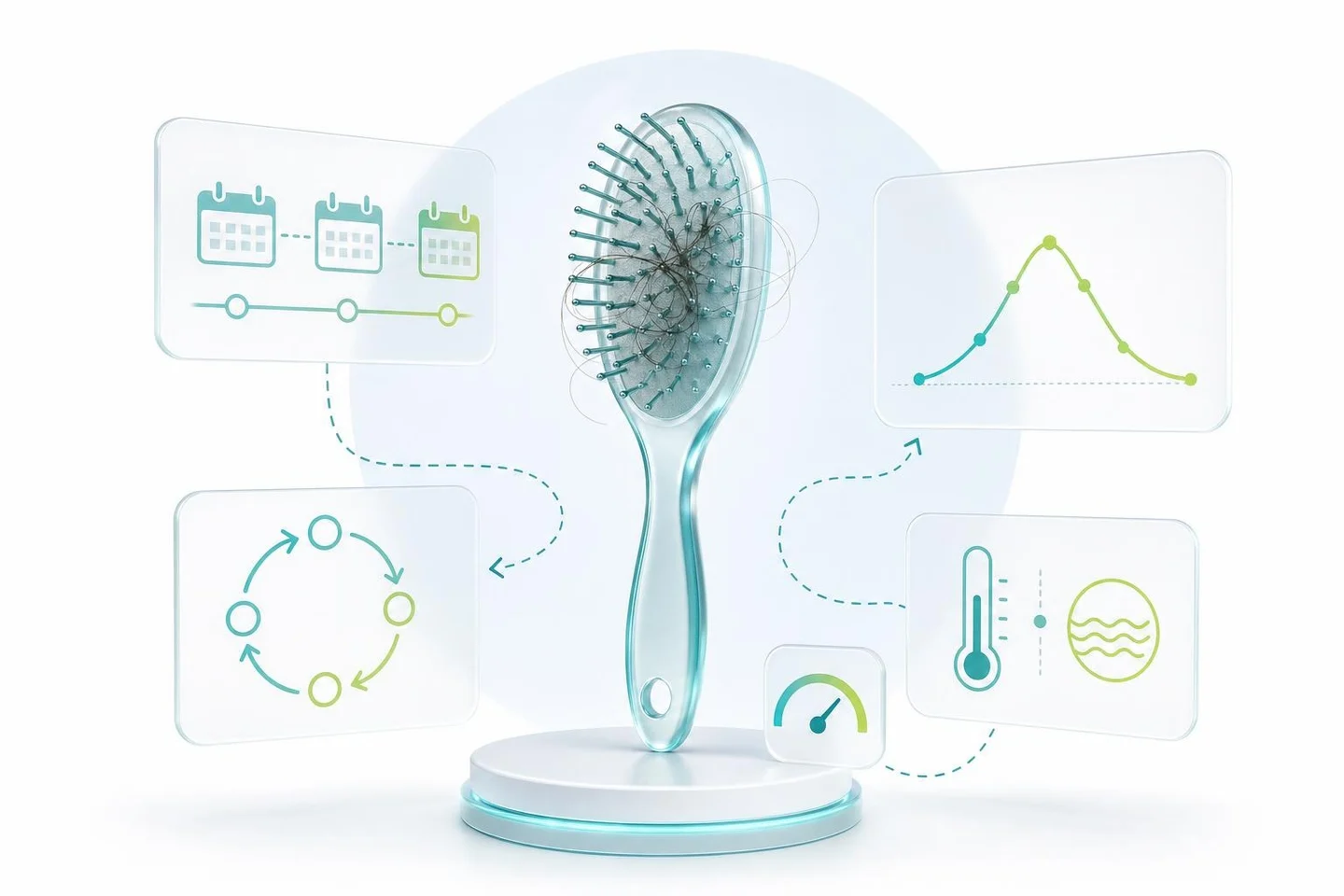
Telogen effluvium is temporary hair shedding that happens when a large number of hair follicles leave the growing phase early, rest at the same time, and then release their hairs a few months later. It typically starts two to three months after a trigger such as a high fever, major surgery, childbirth, rapid weight loss or a medication change, and the shedding is spread across the whole scalp rather than concentrated in patches. The American Academy of Dermatology (AAD) describes this kind of shedding as something that usually stops on its own as the body readjusts, with hair tending to regain its normal fullness within six to nine months.
Each follicle runs its own cycle. The 2024 StatPearls review of telogen effluvium describes a healthy scalp as roughly 85% anagen (growing) hairs and 15% telogen (resting) hairs, with a follicle producing a growing hair for close to four years and then resting about four months. A new growing hair forms underneath the resting one and pushes it out. That is ordinary daily shedding, and AAD puts the normal range at 50 to 100 hairs a day.
Telogen effluvium is a reactive process. StatPearls describes it as excessive shedding of resting hairs after metabolic stress, hormonal change or a medication, and notes that under significant stress about 70% of anagen hairs can shift into the telogen phase early.
The delay is built into the biology. Those hairs sit in the resting phase for one to six months, three months on average, and nothing looks different on the scalp during that stretch. The shedding becomes obvious only when the follicles restart and the old hairs are pushed out. Cleveland Clinic says a person with telogen effluvium may shed up to 300 hairs a day.
StatPearls lists acute febrile illness, severe infection, major surgery, severe trauma, postpartum hormonal change (particularly a drop in estrogen), hypothyroidism, sudden stopping of estrogen-containing medications, crash dieting, low protein intake, heavy metal ingestion and iron deficiency. Cleveland Clinic adds psychological stress and hyperthyroidism to a similar list.
Medications can do it too. StatPearls names beta blockers, retinoids including excess vitamin A, anticoagulants, propylthiouracil, carbamazepine and immunizations as the ones most often linked to telogen effluvium. Cleveland Clinic also lists calcium channel blockers, some antidepressants and NSAIDs.
Illness with fever is a common trigger. AAD notes that people develop excessive shedding after recovering from pneumonia, scarlet fever and the flu, and reports that in studies about 20% of people who had COVID-19 later developed temporary shedding, which usually begins a few months after recovery.
StatPearls also points out that many people have fully recovered from the illness or event by the time the hair starts falling, so the connection is easy to miss.
Acute telogen effluvium is defined by its length. StatPearls states that, by definition, shedding in acute telogen effluvium lasts less than six months, and often much less. Cleveland Clinic gives a usual range of three to six months of shedding and says most cases resolve without treatment within six to eight months once the cause is addressed.
Regrowth lags behind the shedding. StatPearls notes that hair growth may take up to six months to restart, and longer before a person can see the difference. AAD says hair tends to return to its normal fullness within six to nine months after shedding stops.
Postpartum shedding follows the same curve. AAD says shedding usually peaks about four months after giving birth and that most women regain normal hair growth by their child's first birthday, with some getting there earlier. AAD advises seeing a dermatologist if fullness has not returned after a year, because something else may be causing the loss.
AAD also notes that if the stressor stays, the shedding can be long lived.
Chronic telogen effluvium is shedding that keeps going past about six months. Cleveland Clinic describes it as affecting the entire scalp, often without a clear cause, and says the chance of developing it without a detectable cause is higher in women between 30 and 60. It does not cause total baldness, although people may shed in handfuls early on.
A 1996 study by D.A. Whiting in the Journal of the American Academy of Dermatology described the pattern. Whiting classified 355 patients (346 females, 9 males) with diffuse generalized thinning of scalp hair of unknown origin as having chronic telogen effluvium. They had abrupt onset, a fluctuating course, and diffuse thinning across the scalp, often with recession at the temples. Scalp biopsy findings separated this group from androgenetic alopecia. The study is nearly three decades old and came from a single practice, so the numbers describe the patients seen there rather than the general population.
Chronic shedding can also have a specific driver. StatPearls notes that hypothyroidism can lead to chronic telogen effluvium, which is one reason thyroid testing comes up, and says a good cosmetic result is expected in the chronic form even when shedding continues.
Diffuse shedding and inherited thinning can overlap. We cover how to tell them apart in hair shedding vs hair loss, and the inherited pattern in women in female pattern hair loss.
Some shedding needs a workup and some does not. Reasons to book an appointment:
If you suspect a prescription is behind the shedding, talk to a clinician before stopping or changing it.
StatPearls calls acute telogen effluvium self-limited: no further treatment is needed once the cause is identified and handled, and hair growth returns after a deficiency or metabolic problem is corrected or a causative medication is withdrawn. StatPearls states plainly that topical minoxidil has not been proven to promote hair recovery in telogen effluvium, though some patients choose to use it. Cleveland Clinic lists headache, scalp irritation and unusual hair growth among possible side effects of minoxidil, and says you should not use it if you are pregnant or breastfeeding. Any treatment decision belongs to the prescribing clinician.
Usually, though no one can promise it for an individual. StatPearls calls telogen effluvium benign and spontaneously reversible, with a good recovery of hair density expected in the acute form, and Cleveland Clinic describes new growth after the three to six month shedding period. If fullness has not returned within those timeframes, see a dermatologist.
AAD puts normal at 50 to 100 hairs a day. StatPearls describes a home method: collect all shed hair over 24 hours without washing, repeating weekly for three or four collections. Collecting 100 or more hairs in 24 hours suggests telogen effluvium.
Cleveland Clinic lists psychological stress among the triggers, and AAD includes periods of heavy life stress such as caring for a sick relative, divorce or job loss. Physical stressors like fever, surgery and childbirth are better documented. Sometimes no trigger turns up at all: Cleveland Clinic says the chronic form may not have a clear cause, and Whiting's 1996 report described chronic telogen effluvium as starting abruptly with or without a recognizable initiating factor.
Not typically. Cleveland Clinic describes it as diffuse thinning, most noticeable on top of the head, that usually does not affect the hairline or cause total baldness. Patchy bald spots or a clearly receding hairline point toward a different diagnosis and are worth showing to a clinician.
Alopecia areata is an autoimmune cause of round, patchy hair loss. Signs, alopecia totalis and universalis, and dermatologist-led treatments.
Read articleWhat female pattern hair loss looks like, why the part widens while the hairline stays, and the conditions a clinician checks for first.
Read articleHow inherited androgen sensitivity and DHT shrink scalp follicles, how pattern loss progresses, and which other causes of hair loss look similar.
Read articleOpening soon
SimpleHumans is opening soon. Join the early-access list and you'll be first to know when we launch — plus an exclusive discount reserved for people who sign up before we open.
You're on the list
Thanks for joining. We'll email you when we launch, along with your founding-member discount.
