

How Long Does Semaglutide Stay in Your System?
FDA labels put semaglutide's half-life at about a week and tirzepatide's at about five days. What that means for pregnancy plans and procedures.
Read articleWhat drug labels, FDA post-marketing reports and observational studies say about GLP-1 gastroparesis, delayed gastric emptying and warning signs.
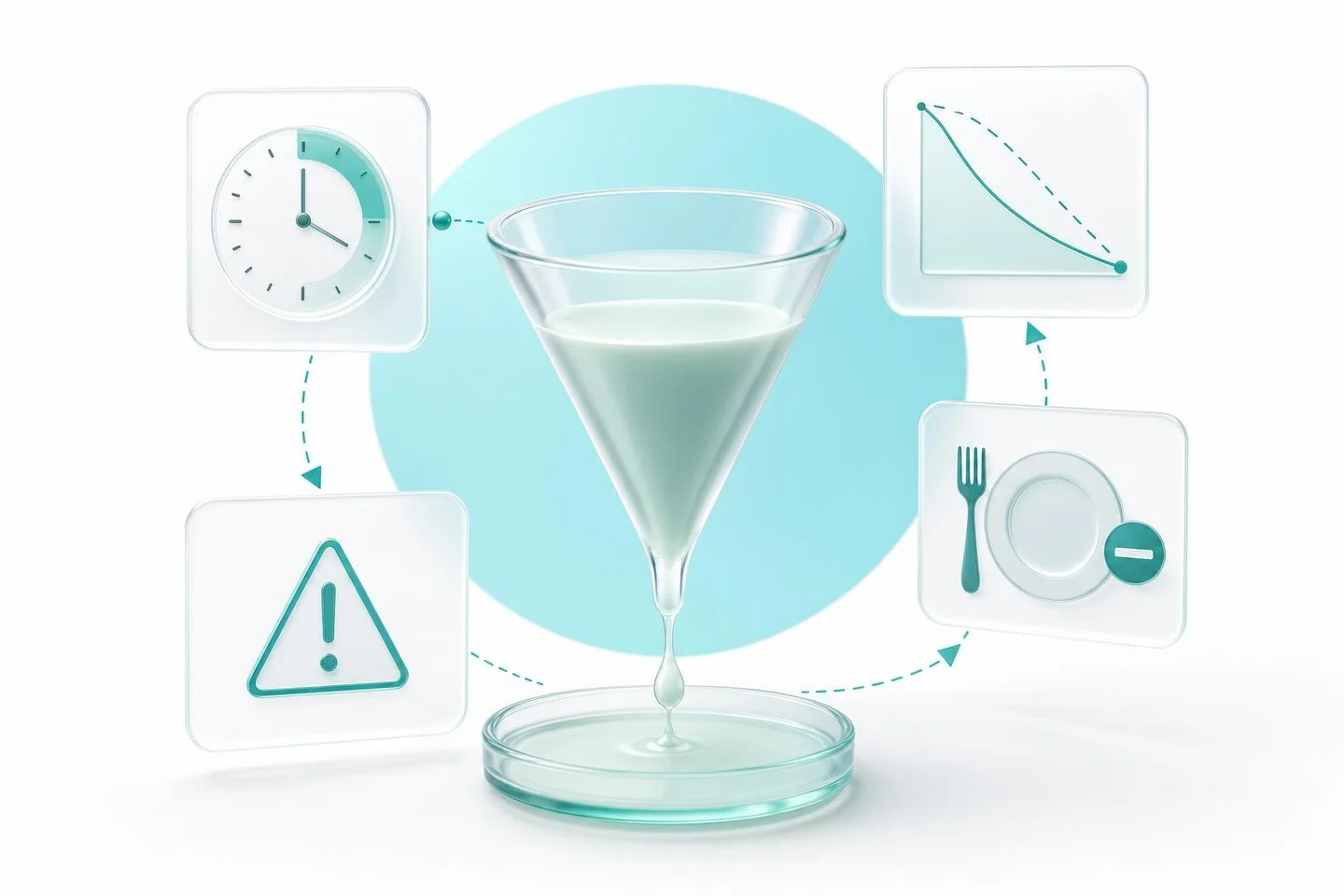
GLP-1 medications slow how quickly food leaves the stomach, and that slowing is part of how they reduce appetite. Gastroparesis is a disorder that slows or stops the movement of food from the stomach into the small intestine even though nothing is blocking it. The labels for the FDA-approved semaglutide and tirzepatide products both state that the drug delays gastric emptying, and both say the medication is not recommended in people with severe gastroparesis.
Nausea and early fullness are common on these medications. Vomiting that stops you from keeping food or fluids down is different, and it needs prompt medical attention rather than waiting.
Slowed emptying is a built-in effect of the drug class, not a sign that something has gone wrong. A 2026 review in Diabetes, Metabolic Syndrome and Obesity describes GLP-1 receptor agonists as acting on receptors in the gut and the brain, slowing gastric emptying and suppressing appetite, with weight loss driven mainly by eating less rather than by burning more.
The FDA-approved semaglutide label states plainly that semaglutide delays gastric emptying. The FDA-approved tirzepatide label adds a detail worth knowing: the delay is largest after the first dose and the effect diminishes over time.
The same slowing explains some of the everyday discomfort. The 2026 review attributes nausea, reduced appetite, early fullness and constipation to a mix of brain pathways and gut pathways, including delayed emptying and reduced intestinal motility. Both labels also note that because the stomach empties more slowly, absorption of oral medications taken at the same time may be affected.
The symptoms overlap heavily, which is why they are hard to tell apart without testing. According to NIDDK, gastroparesis symptoms include feeling full soon after starting a meal, feeling full long after eating, nausea, vomiting, a lot of bloating or belching, upper abdominal pain, heartburn and poor appetite.
Those are also the complaints most people report on a GLP-1. In the adult weight reduction trials in the FDA-approved semaglutide injection label, nausea was reported by 44% of people on semaglutide and 16% on placebo, diarrhea by 30% versus 16%, vomiting by 24% versus 6%, and constipation by 24% versus 11%.
NIDDK makes a distinction that applies here. It lists medicines that may delay gastric emptying or worsen symptoms in people who already have gastroparesis, including opioid pain medicines, some antidepressants, anticholinergics and pramlintide, and states that these medicines do not cause gastroparesis. A medication effect on stomach motility and a chronic motility disease are not the same thing, even when they feel similar.
What matters in practice is severity and duration. Side effects that ease as the body adjusts are different from vomiting that persists for weeks or keeps you dehydrated. For the usual time course, see semaglutide side effects and how long they last.
Both approved products carry a warning about severe gastrointestinal reactions. In the adult weight reduction trials, severe gastrointestinal adverse reactions were reported in 4.1% of people on semaglutide injection and 0.9% on placebo. In a pool of two tirzepatide weight reduction trials, severe gastrointestinal reactions ranged from 1.7% to 3.1% across doses, compared with 1% on placebo.
Post-marketing reports listed on both labels include ileus, intestinal obstruction, severe constipation including fecal impaction, and acute pancreatitis. The labels state the standard caveat for such reports: because they come in voluntarily from a population of uncertain size, it is not always possible to estimate how often they happen or to establish that the drug caused them.
Both labels also describe rare post-marketing reports of pulmonary aspiration during general anesthesia or deep sedation in people taking GLP-1 receptor agonists who had food still in the stomach despite following fasting instructions. The semaglutide label instructs patients to tell their healthcare providers about any planned surgery or procedure. That is one of the more practical things to carry away from this article.
One frequently cited study is a 2023 research letter in JAMA by Sodhi and colleagues, which used a US health claims database to compare people with obesity and no diabetes who started semaglutide or liraglutide against people who started bupropion-naltrexone. Compared with bupropion-naltrexone, GLP-1 use was associated with a higher risk of gastroparesis (hazard ratio 3.67, 95% CI 1.15 to 11.90), bowel obstruction (4.22, 1.02 to 17.40) and pancreatitis (9.09, 1.25 to 66.00), but not biliary disease.
The limits are large. The cohort contained 613 semaglutide users, 4,144 liraglutide users and 654 comparison users, and gastroparesis was counted using a diagnosis code or a prescription for a promotility drug rather than a confirmed test. The confidence intervals are wide, which means the true size of any effect is uncertain. The authors noted they could not be sure every GLP-1 prescription was for weight loss, and that these events are rare.
The 2026 review in Diabetes, Metabolic Syndrome and Obesity reaches a cautious conclusion across the wider literature: findings on gastroparesis, intestinal obstruction and ileus have been heterogeneous and sometimes conflicting, confirming gastroparesis is difficult because gastric emptying scintigraphy is not routinely performed, and a definitive causal link between GLP-1 therapy and severe motility disorders has not been established. The same review advises clinicians to stay alert for symptoms that suggest delayed emptying or obstruction and to evaluate persistent symptoms promptly.
NIDDK says to seek a doctor's help right away for vomiting for more than an hour, severe abdominal pain or cramping, sudden sharp stomach pain that does not go away, red blood in vomit or vomit that looks like coffee grounds, extreme weakness or fainting, difficulty breathing, or fever. It also advises getting help for signs of dehydration, such as extreme thirst, dry mouth, urinating less than usual, dark urine or light-headedness.
Being unable to keep food or fluids down for more than a day is a reason to call a clinician, not a reason to push through to the next injection. The same goes for abdominal pain severe enough to double you over, which both labels link to pancreatitis as a possible cause.
For milder symptoms, the 2026 review describes first steps such as smaller and more frequent meals, avoiding high-fat and spicy foods, stopping when you feel full, and keeping up fluid and fiber intake, followed by holding the dose steady or reducing it if symptoms continue past the early weeks. Your prescribing clinician sets and adjusts the dose, including pausing it. Our guide to what to eat on a GLP-1 covers the food side in more detail.
Everything above comes from the labels and trials of FDA-approved products. Compounded medications are not FDA-approved, and FDA does not verify the safety, effectiveness or quality of compounded drugs before they are marketed. Results from trials of an FDA-approved product are not evidence about a compounded version.
SimpleHumans offers compounded semaglutide and compounded tirzepatide on a conditional basis only, when a clinician documents patient-specific clinical necessity. Neither is a substitute for an FDA-approved product. If you have a history of gastroparesis, frequent vomiting, prior bowel obstruction or another motility problem, that belongs in the medical history you give the clinician reviewing your request.
"Stomach paralysis" is an informal name for gastroparesis, which NIDDK defines as slowed or stopped movement of food out of the stomach with no blockage present. The FDA-approved semaglutide label states the drug delays gastric emptying and is not recommended in people with severe gastroparesis. Whether the medication causes new, lasting gastroparesis is not settled; the 2026 review in Diabetes, Metabolic Syndrome and Obesity says a causal relationship with severe motility disorders has not been established.
The labels for both FDA-approved products say the medication is not recommended in people with severe gastroparesis. Milder or suspected motility problems are a judgment call for a clinician who knows your history and other medications.
Not necessarily at the same strength. The FDA-approved tirzepatide label reports that the effect on gastric emptying was greatest after the first dose and diminished with later doses.
By measuring how fast the stomach empties. The 2026 review names gastric emptying scintigraphy, a scan that tracks a labeled meal, as the diagnostic standard, and notes it is not consistently performed in routine practice, which is part of why claims-based studies of this question are hard to interpret.
FDA labels put semaglutide's half-life at about a week and tirzepatide's at about five days. What that means for pregnancy plans and procedures.
Read articleIncretin hormones are gut hormones that raise insulin after eating. What GLP-1 and GIP do, and how that physiology led to today's medications.
Read articleA GLP-1 agonist is a medicine that copies a hormone your body makes. How the class works, which molecules are in it, and where compounded versions fit.
Read articleOpening soon
SimpleHumans is opening soon. Join the early-access list and you'll be first to know when we launch — plus an exclusive discount reserved for people who sign up before we open.
You're on the list
Thanks for joining. We'll email you when we launch, along with your founding-member discount.

